
Discover How Cloud-Based ERP Transforms Flooring Businesses
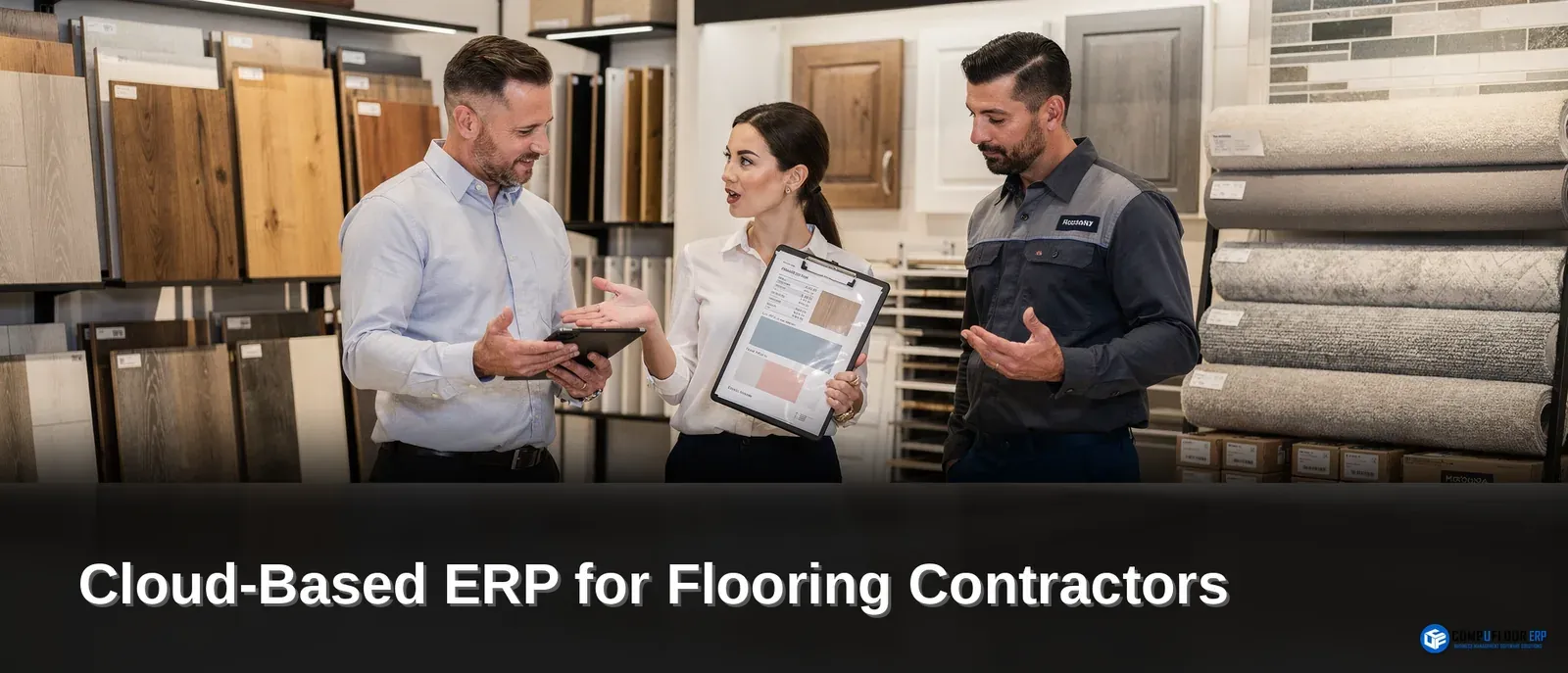
Cloud ERP platforms like Comp-U-Floor ERP give flooring dealers, retailers, and remodeling contractors a centralized system for lead tracking, quote preparation, sales order conversion, inventory management, and multi-store point-of-sale operations. Built from over 40 years of combined flooring and software expertise, this solution streamlines estimating, scheduling, and job progress tracking across every location and field team.
Key Takeaways
-
Comp-U-Floor ERP is built on a collaboration of software experts and flooring veterans with over 30 years of combined experience.
-
Comp-U-Floor ERP supports businesses of various sizes with capabilities tailored for large-scale flooring operations.
-
Cloud ERP systems manage complex flooring industry variables including inventory, purchasing, pricing, installation-management, and operational details efficiently.
-
Flooring ERP software integrates wholesale distribution, surfaces management, and business reporting into unified platforms.
Why Are Flooring Businesses Moving to Cloud ERP?
Job variables shift constantly in the flooring trade — material costs, crew schedules, client change orders. And paper-based or disconnected systems cannot keep pace. Owners lose hours reconciling spreadsheets while competitors close deals faster. A cloud-based ERP for flooring contractors consolidates every moving part into a single, accessible system, cutting the administrative drag that eats into margins.
Wholesale distribution adds another layer of difficulty. Flooring distributors must satisfy demanding customers while managing supplier relationships, inventory accuracy, and delivery timing simultaneously. Cloud ERP platforms address this by centralizing quoting, purchasing, and fulfillment data so operations managers see the full picture in real time, not days later.
Comp-U-Floor ERP grew out of a partnership between software developers. Flooring industry veterans with over 30 years of combined management experience. That pairing shaped a platform built for how flooring businesses actually operate, not a generic system retrofitted for the trade. Headquartered in Maitland, Florida, the company designed its ERP specifically around estimating, sales, and job tracking demands unique to flooring and remodeling contractors.
What makes cloud ERP different from traditional flooring software?
Traditional systems often live on a single desktop or server, limiting access to one location. Cloud ERP removes that barrier, giving owners and field teams access from any device with a connection.
Does cloud ERP help multi-location flooring dealers?
Yes. Centralized data means every location works from the same estimates, inventory records, and job statuses. Contractors managing multiple showrooms or warehouse sites avoid the disconnected reporting that plagues location-by-location systems.
Key advantages driving adoption include:
-
Centralized job and estimate data across every branch
-
Reduced manual reconciliation between departments
-
Real-time visibility for owners and operations managers
-
Faster response to shifting material and labor variables
What Core Modules Define a Flooring ERP?
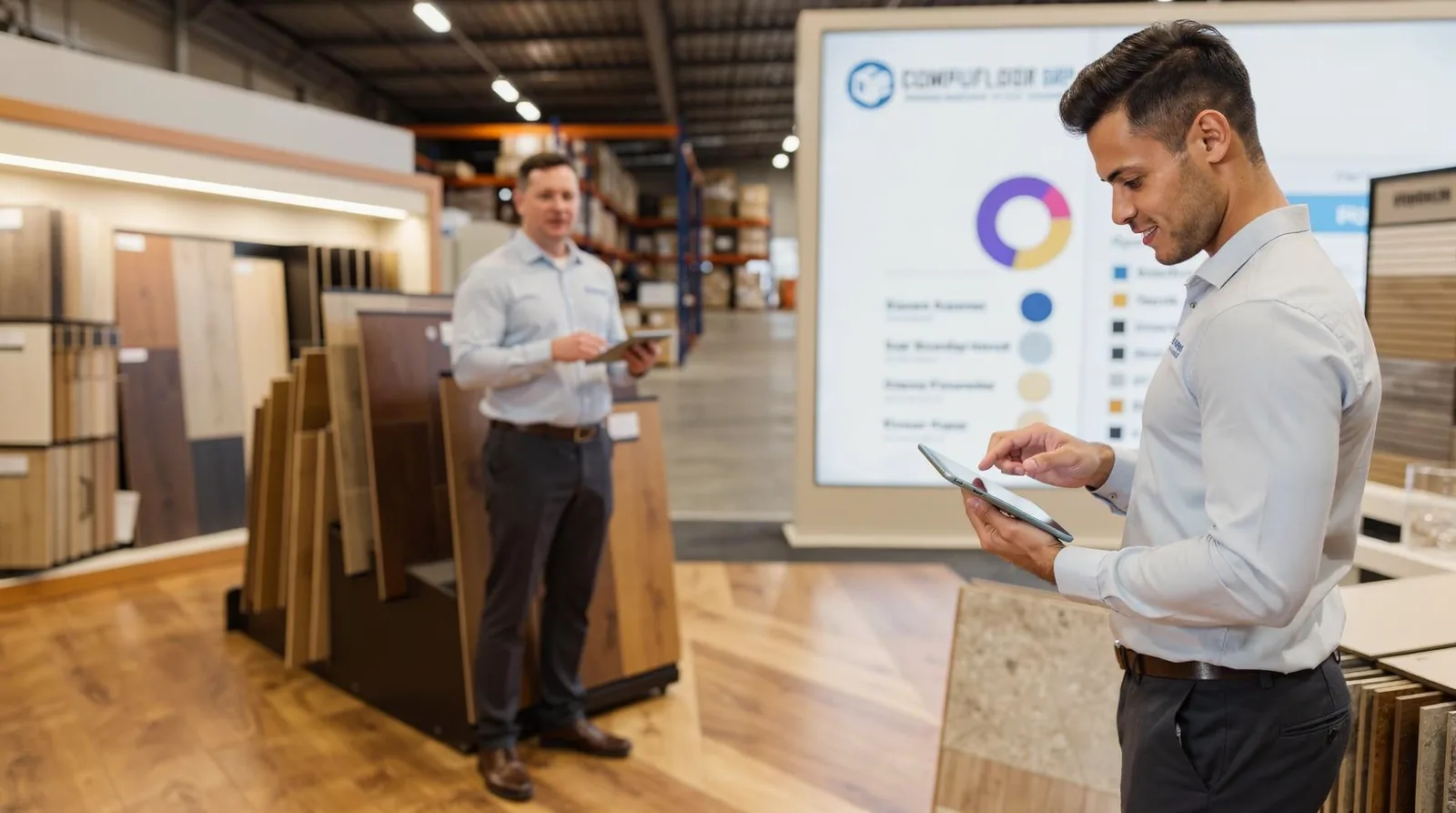
Six modules separate a genuine flooring management system from a generic spreadsheet: estimating, customer relationship management, sales order processing, inventory control, purchasing, and job installation management. Missing even one of these creates blind spots that cost dealers time, margin, and repeat business. A cloud-based ERP for flooring contractors ties these functions into a single record. Estimators, installers, and office staff work from identical numbers.
Estimating sits at the center. Comp-U-Floor’s cloud-based platform generates accurate, detailed client estimates in a fraction of the time manual methods require, freeing staff to focus on selling rather than recalculating square footage.
Does a flooring ERP need a built-in CRM?
Yes. A flooring ERP without customer relationship tools forces dealers to juggle separate software just to track a lead. Comp-U-Floor already includes a built-in CRM designed specifically for flooring professionals, eliminating that extra subscription and the data gaps that come with it. The CRM module monitors new leads from first contact, streamlines daily workflow, and logs every customer interaction, which helps sales teams close more deals.
What does the CRM actually track?
The system follows a prospect through the entire sales journey, not just the first inquiry. Coverage includes:
-
Lead tracking — captures and monitors new leads entering the business
-
Lead qualification — converts raw leads into active prospects
-
Prospect management — guides prospects through product selection and estimating
-
Quote preparation — builds professional quotes inside the same system
-
Sales order conversion — turns accepted quotes directly into sales order jobs
Beyond individual modules, an enterprise-wide floor covering system reorients the entire operation around the customer. Dealers running disconnected tools often lose visibility the moment a job moves from estimate to installation. Consolidated modules close that gap and keep every location working from one accurate source of truth.
How Does ERP Manage Inventory and Warehousing?
Enterprise resource planning software tracks material stock, purchasing, and warehouse movement from a single system. A cloud-based ERP for flooring contractors eliminates the guesswork of manual spreadsheets and disconnected point-of-sale tools. Flooring dealers lose visibility fast when inventory data lives in three different systems; unified platforms close that gap.
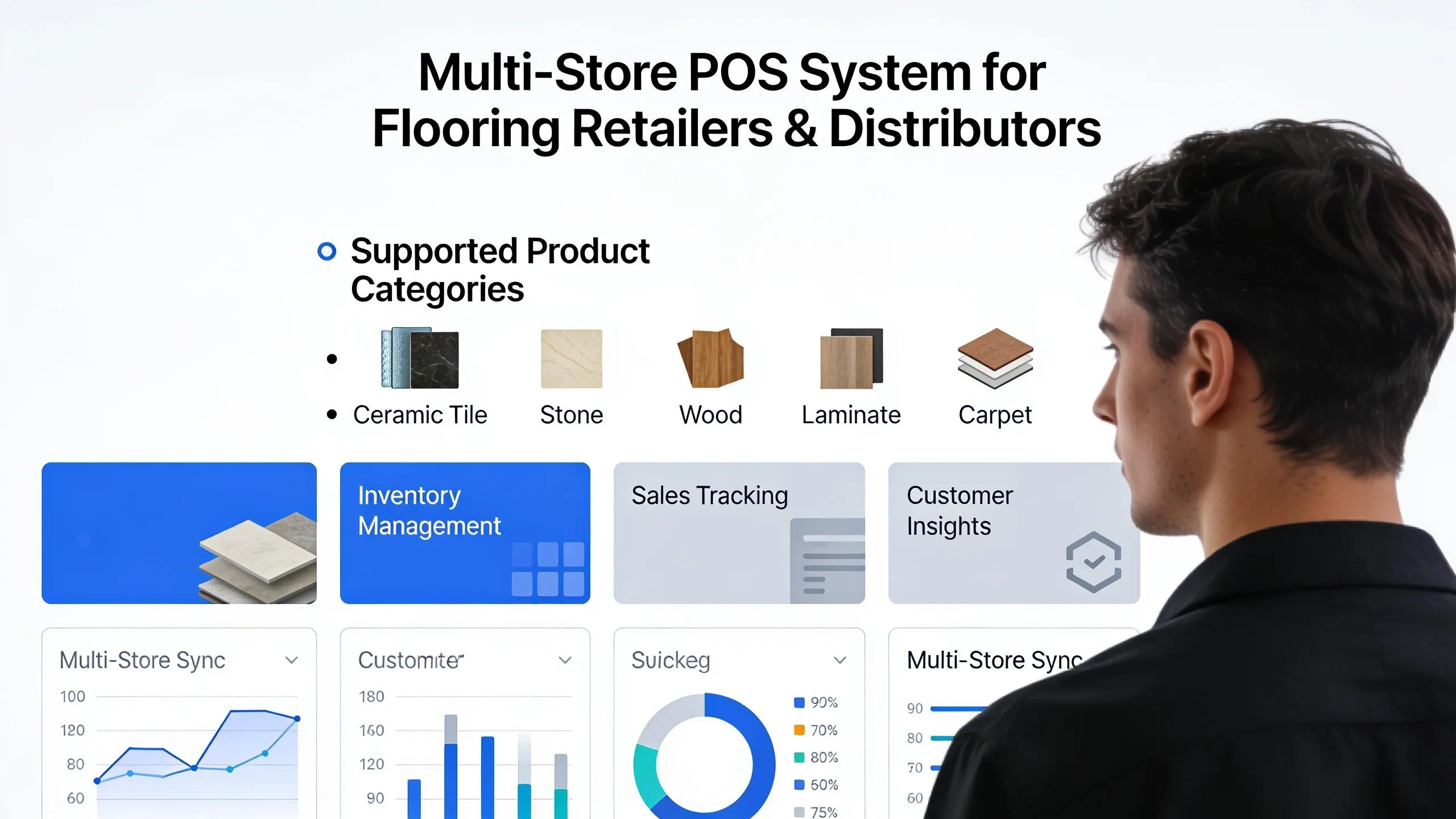
Multi-store point-of-sale functionality forms the backbone of this visibility. Comp-U-Floor’s system fits the operational needs of ceramic tile, stone, wood, laminate, and carpet retailers, residential & commercial installers, and distributors, regardless of location count. Each store transaction updates centrally, so owners see stock levels across every showroom without phoning individual locations.
What does inventory software offer stone fabricators specifically?
Fabricators face unique material-tracking challenges compared to standard retailers. Comp-U-Floor’s flooring inventory management tools keep detailed records of every material on hand, reducing waste from overordering or lost stock. Sales order, purchasing, and inventory modules include features built specifically for stone fabrication workflows, addressing slab tracking and remnant management that generic ERP systems often overlook.
How does the system speed up warehouse sales?
Point-of-sale tools process cash-and-carry transactions quickly in both showrooms and warehouses. The system handles charges to sub-contractors and tile setters holding open accounts, keeping credit relationships organized without separate ledgers.
Warehouse efficiency depends on paperwork speed as much as stock accuracy. Consider the typical sales cycle:
-
A sales invoice generates automatically, reflecting charges and payment received.
-
An optional pick-ticket prints directly at the warehouse, expediting order fulfillment.
-
Sub-contractor accounts stay linked to jobs for accurate billing.
These functions combine to shrink the time between order entry and material pickup, protecting margins on every transaction.
Which Businesses Benefit Most from Flooring ERP?
Retailers, installers, fabricators, and multi-location distributors gain the most from Cloud-Based ERP for Flooring Contractors, each for different operational reasons. Residential and commercial installers rely on order entry that lets crews add labor lines, comments, and notes directly to a quote, then carry those details straight through to the sales ticket. That continuity removes guesswork on the job site and keeps billing accurate from estimate to final invoice.
The Comp-U-Floor ERP Mobile App keeps installers connected to headquarters in real time, streamlining job-site updates from start to finish.
Professional quotes matter just as much as the work itself. Quotes built with labor lines, installation guidelines, and job specifics give customers a clear picture of scope before a crew ever arrives, reducing disputes and change orders later.
Does flooring ERP work for multi-family or property-based contracts?
Yes — an optional module tracks buildings and apartments contracted for floor replacement, which suits contractors serving property managers and real estate portfolios. The module establishes links with real estate management companies and building owners directly inside the system. That connection saves time on repeat contracts and creates efficiency across large residential accounts.
Which company sizes see the biggest advantage?
Scale changes what a business needs from its software. Smaller shops need speed and simplicity; larger operations need structure.
Operations running 25 or more users require enterprise-grade capability, not a stripped-down tool built for single-location shops. Wholesale distributors face a related challenge: coordinating quotes, inventory control, and daily operations across multiple warehouses. Unifying those functions in one system replaces scattered spreadsheets with a single source of truth, giving owners and operations managers real visibility into every job, every location, and every crew.
How Do You Get Started with Flooring ERP?
Getting started begins with mapping where sales, estimating, and inventory processes currently break down. Flooring dealers lose time and margin when customer demands and supplier relationships get managed through disconnected spreadsheets and phone calls. A Cloud-Based ERP for Flooring Contractors replaces those fragmented steps with one connected system built specifically for the industry.
What should a flooring business look for first?
The clearest starting point is a platform that shortens the distance between customer contact and closed sale. Comp-U-Floor ERP’s “One-Step Competitive Advantage” feature lets sales staff build a floor estimate, present a quote, and close the sale. Deposit payment included — all at the point of contact. That single capability eliminates several handoffs that typically stall a deal.
How does ERP change daily operations?
ERP software automates the extra administrative steps that pull attention away from customers. By streamlining estimating, scheduling, and material tracking, the business focus shifts back where it belongs: serving the client, not chasing paperwork.
Business owners evaluating vendors should confirm the provider understands flooring-specific workflows, not generic retail operations. Comp-U-Floor ERP, headquartered in Maitland, Florida, was built around that specialization. Scheduling a demo remains the most direct way to see how the platform fits an existing flooring enterprise. From quote through a successful Delivery and Installation process before committing to a full rollout.
Why Comp-U-Floor ERP is the Competitive Edge for Flooring Businesses
Cloud-based ERP for flooring businesses ultimately comes down to replacing fragmented spreadsheets and phone calls with one connected system built for the trade. Comp-U-Floor ERP centralizes estimating, CRM-driven lead tracking, sales order conversion, inventory control, material-purchasing, and multi-store point-of-sale operations, giving flooring dealers, installers, and distributors a single accurate view of every job and location. Whether the priority is faster quotes, tighter warehouse visibility, or coordinating multi-family property contracts, a purpose-built flooring ERP closes the gaps that generic software leaves behind. For flooring businesses ready to see these capabilities firsthand, scheduling a demo is a natural next step toward a more connected operation.
FAQ
What is cloud ERP for flooring businesses?
A centralized system that manages lead tracking, quote preparation, sales order conversion, inventory management, and multi-store point-of-sale operations for flooring dealers, retailers, and remodeling contractors.
How does cloud ERP benefit multi-location flooring dealers?
Centralized data gives every location access to the same estimates, inventory records, and job statuses, eliminating the disconnected reporting that plagues location-by-location systems.
What modules define a genuine flooring ERP system?
Anchored by a solid financial engine, the ERP system integrates six vital operations: estimating, CRM, sales ordering, inventory management, purchasing, and job scheduling. Leaving any of these out creates blind spots that bleed time and margin.
Research & Sources
The case for cloud-based ERP in flooring rests on documented industry patterns as well as Comp-U-Floor’s own operating history:
-
Founding expertise. Comp-U-Floor ERP was built through a direct collaboration between software developers and flooring industry veterans holding over 30 years of combined management experience — grounding the platform’s design in real flooring operations rather than generic retail software adapted after the fact. (comp-u-floor.com)
-
Industry-wide shift toward cloud-integrated systems. Broader trends in the flooring dealer market show a growing emphasis on cloud-integrated solutions and real-time data access, with dealers increasingly prioritizing technology that supports operational scalability and efficiency. (comp-u-floor.com)
-
Efficiency and cash-flow impact. Streamlined, cloud-based processes are consistently linked to faster transaction and revenue-collection cycles, along with more informed, data-driven decision-making — outcomes that directly support the margin and visibility gains discussed throughout this article. (comp-u-floor.com)
-
Competitive positioning. Flooring businesses that integrate ERP systems are positioning themselves to compete more effectively as the broader market continues moving toward cloud solutions, reinforcing why estimating, CRM, inventory, and point-of-sale functions benefit from living in one connected platform.