
ERP Software for Project Management Success

Flooring contractors maximize project efficiency with ERP software by consolidating estimates, quotes, inventory, and sales orders into one connected platform. Comp-U-Floor ERP replaces manual lead tracking with automated prospect management, converting quotes into sales orders and eliminating bottlenecks that delay installations, reduce accuracy. Erode profitability across flooring and remodeling projects.
Key Takeaways
-
ERP systems unify disconnected departments, eliminating costly workflow fragmentation across project teams.
-
Comprehensive project management solutions enhance resource allocation, budget control, and deadline adherence simultaneously.
-
Integrated ERP platforms reduce frustration from managing multiple separate accounting and scheduling systems.
-
Project-based businesses including manufacturing, construction, consulting, and engineering firms achieve measurable profitability gains.
Why Do Flooring Projects Bleed Profit and Time?
Profit disappears when estimating, inventory, scheduling, and customer communication run on separate tracks instead of one system. Flooring business owners manage all four simultaneously, and each handoff between them creates a point of failure. A missed inventory update or a delayed schedule change rarely stays contained; it ripples into the next job.
Slow workflows remain common across the flooring industry, and so do estimating mistakes. Inventory mismanagement compounds the problem, quietly eating into margins long before an owner notices the pattern. These issues rarely announce themselves as a single crisis. Instead, they accumulate as small delays and pricing errors that add up over a fiscal year.
What causes the most operational friction on flooring jobs?
Disconnected departments cause the bulk of the friction. When accounting, scheduling, and field operations each run on separate tools, teams duplicate work and lose time reconciling records. That disconnect proves both frustrating and costly for a dealership trying to keep multiple projects moving at once.
Common friction points include:
-
Estimating errors that require rework or shrink margins after a bid is accepted
-
Inventory headaches from manual tracking across warehouses and job sites
-
Scheduling conflicts between installation crews and material availability
-
Siloed communication between sales, operations, and accounting teams
ERP software for project management addresses these gaps by unifying the workflow into a single operational view. Instead of chasing updates across spreadsheets, phone calls, and separate systems, project managers work from one accurate source. That consolidation is what closes the gaps where profit and time quietly leak out.
Research: Industry Trends & Case Evidence
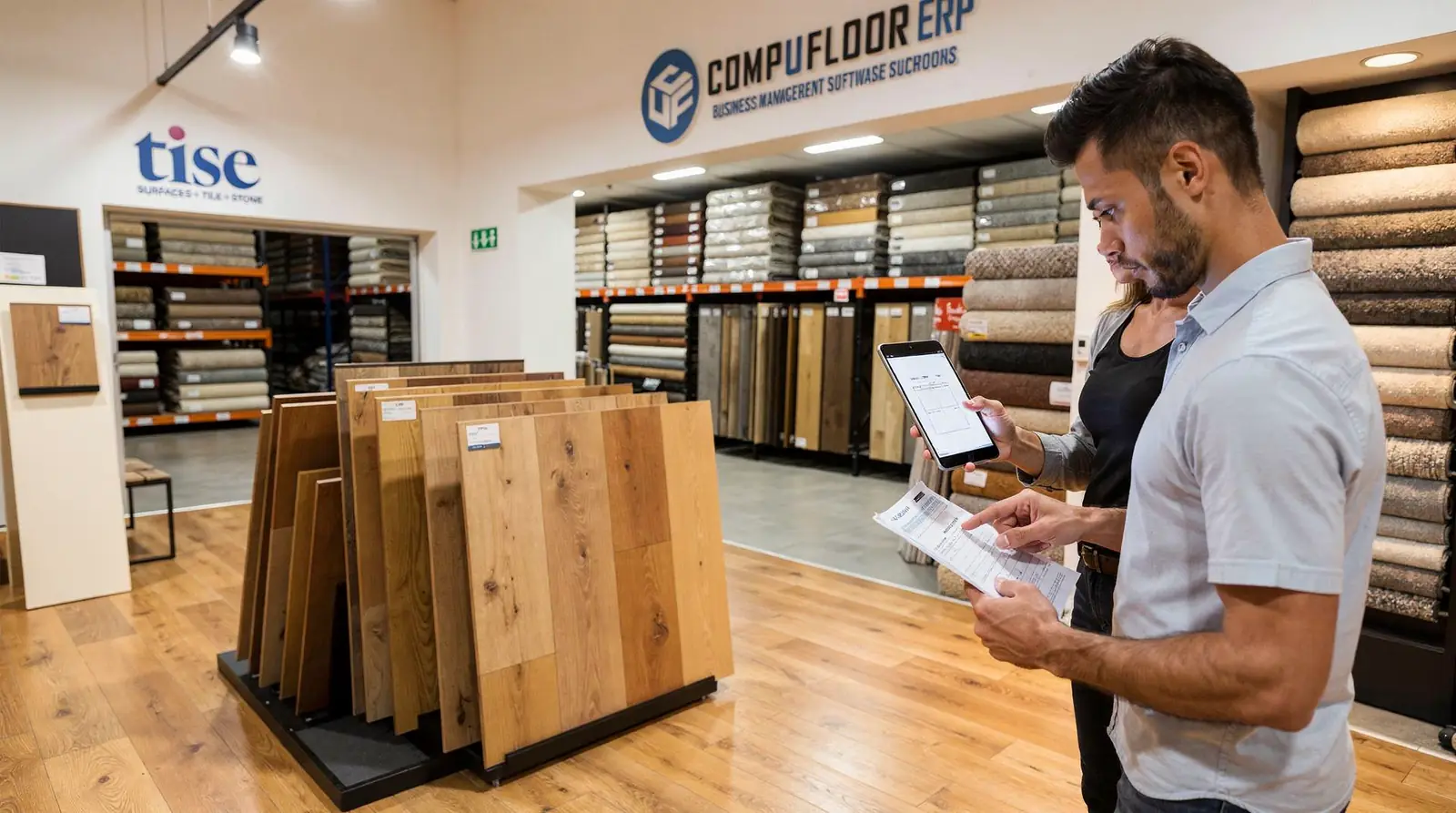
Case studies of flooring businesses that have adopted ERP systems document measurable efficiency gains and cost reductions once fragmented, department-by-department workflows give way to a single connected platform. The same pattern holds at the industry level: flooring dealers are moving toward cloud-integrated, real-time systems as operational scalability and efficiency increasingly depend on it.
Academic research on cloud ERP adoption backs this shift. A 2025 study proposes an AI-driven, analytics-based cloud framework — the “Eagle Eye Framework for Enterprise-Wide Resource Planning” — built specifically to address common adoption barriers such as vendor lock-in, limited empirical validation, and the lack of rigorous cost-benefit analysis (S. Kumar Gooda, “Cloud-Based Solutions for Scalable Enterprise Resource Planning Systems: Benefits and Implementation Strategies,” 2025). For flooring businesses weighing a switch, that research reinforces what the case studies already show: cloud ERP delivers real-time access from any location and cuts the on-site infrastructure investment competitors still carry.
What Sets Project-Based ERP Apart?
Purpose-built design separates project-based ERP from generic business software. ERP Software for Project Management is engineered specifically to help project-driven companies identify, win, and deliver jobs successfully, rather than forcing flooring operations into a generic accounting mold. This distinction matters for contractors managing dozens of concurrent installations, each with its own materials list, labor schedule, and client timeline.
Traditional business software organizes around departments — accounting here, scheduling there, inventory somewhere else entirely. Project-based ERP flips that structure. It integrates every business function around the project lifecycle itself, from initial lead through final walkthrough, encompassing every process a project-based organization runs into one connected solution. Nothing gets lost in translation between disconnected systems.
Comp-U-Floor was built on that same principle. The platform replaces fragmented legacy tools with a single system, delivering operational capabilities flooring businesses could not previously access in one place.
How does this show up in daily sales work?
Comp-U-Floor’s Sales Order Processing module demonstrates the difference clearly. A sales representative builds a floor estimate, presents a quote, and closes the sale — including a credit card deposit payment — in one continuous step. Competing systems often split these tasks across separate screens or separate software entirely, costing valuable minutes with every customer interaction.
That one-step advantage reflects the core philosophy behind project-based ERP:
-
Lifecycle integration — every stage of a job, connected in one workflow
-
Single-platform operation — no switching between disconnected tools
-
Faster sales conversion — quote-to-close without redundant data entry
Flooring executives evaluating software platforms should weigh this lifecycle-first design against tools that merely bolt project features onto generic accounting frameworks.
How Does ERP Simplify Job Scheduling and Tracking?
Job scheduling and tracking improve when a single platform connects the quote, the sales ticket, and the warehouse floor. ERP software for project management eliminates the disconnected spreadsheets and paper tickets that cause missed installations and material shortages. Consolidating planning, budgeting, and timelines into one real-time, automated platform gives flooring businesses control over complexity and accountability at every project stage.
Comp-U-Floor’s order entry system carries labor lines, comments, and installation notes straight from the original quote into the sales ticket. Nothing gets re-typed, and nothing gets lost between departments. A crew arriving on-site sees the same instructions the estimator wrote weeks earlier, cutting the miscommunication that stalls job timelines.
How does the software support showroom and warehouse sales?
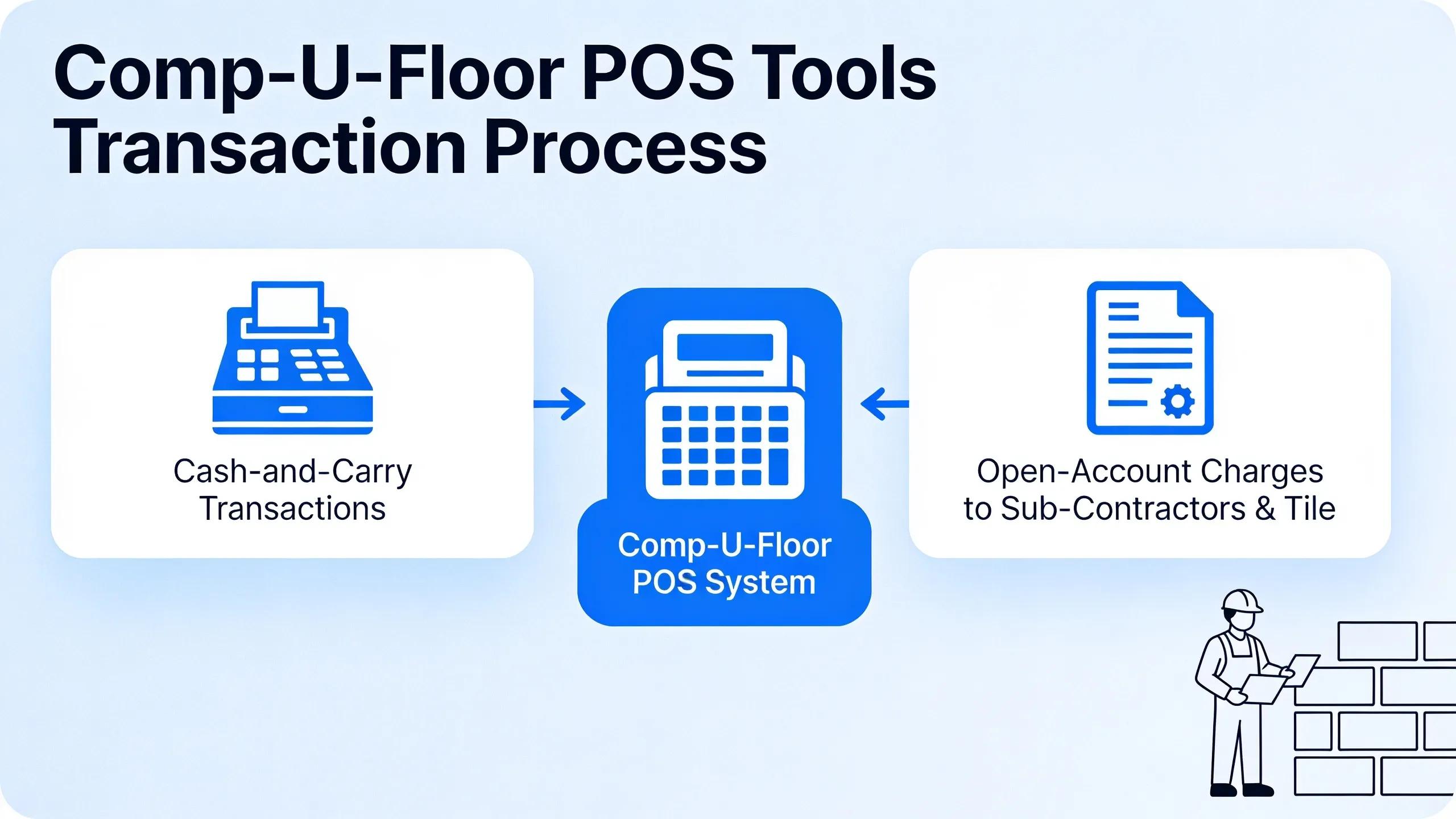
Point-of-sale tools handle cash-and-carry transactions quickly, along with open-account charges to sub-contractors and tile setters. Showrooms and warehouses process these sales without slowing down other scheduling functions, keeping front-counter activity separate from back-office project tracking.
Does the system track material availability for scheduled jobs?
Inventory management software keeps continuous, ongoing track of flooring materials across the sales, purchasing, and inventory modules. That visibility matters directly for scheduling:
-
Crews avoid arriving to incomplete material stock.
-
Purchasing teams reorder before shortages delay installation dates.
-
Project managers confirm job readiness before locking in a schedule.
Flooring contractors juggling multiple installation crews cannot afford scheduling built on guesswork. Commercial flooring executives overseeing several concurrent projects need budgeting, timelines, and labor notes living in one accountable system, not scattered across separate tools. Comp-U-Floor’s structure links the quote, the order, the inventory count, and the schedule, so job tracking reflects what is actually happening on-site rather than what was planned weeks earlier.

How Does ERP Improve Estimating and Sales Accuracy?
Estimating accuracy rises when flooring businesses centralize customer data, quoting, and sales tracking inside one platform. Centralization removes the guesswork that scattered spreadsheets and disconnected tools create. Comp-U-Floor ERP addresses this directly by combining customer management with estimating tools built specifically for flooring and remodeling professionals.
ERP software for project management improves estimating accuracy largely through its ability to centralize project information into a single accessible source. When contractors and project managers pull customer history, material costs, and job details from one location, fewer figures get lost or duplicated during the quoting process. That consistency shows up directly in fewer estimating errors and faster sales cycles.
A built-in customer relationship management (CRM) system plays a central role in this accuracy. The CRM streamlines workflow, tracks every customer interaction, and helps sales teams close more flooring deals without switching between separate applications.
Does Comp-U-Floor Require a Separate CRM Tool?
No. Comp-U-Floor ERP already includes a built-in CRM designed specifically for flooring professionals. Unlike systems that force businesses to purchase. Integrate third-party CRM software, this approach keeps customer records and estimating tools under one roof.
Retail and distribution operations benefit as well. Comp-U-Floor’s multi-store point-of-sale system fits the business needs of ceramic tile, stone, wood, laminate, and carpet retailers and distributors, keeping sales transactions consistent across every location.
Consider what estimating accuracy delivers across a flooring operation:
-
Fewer pricing discrepancies between quotes and final invoices
-
Faster prospect-to-sale conversion through streamlined workflows
-
Consistent customer records across multiple stores or warehouses
-
Reduced reliance on separate, disconnected software tools
Together, these capabilities turn estimating from a guessing game into a repeatable, trustworthy process for contractors and project managers alike.
Research: Estimating Accuracy & ROI
Flooring businesses adopting integrated estimating software have reported cutting estimate errors by roughly 50% and shortening estimate cycle times by about 40%, while a retail flooring showroom that improved estimating accuracy saw annual revenue climb 12% from repeat contracts. The typical ROI timeline for flooring management software implementations runs 6 to 12 months, with reported software ROI across flooring businesses averaging 120–150% within the first year as operational savings and additional project wins compound.
Academic research reinforces the case for structured, data-driven estimating in flooring: a life-cycle cost analysis of commercial flooring alternatives developed a replicable protocol for assessing the best financial value between flooring options — the kind of disciplined comparison centralized estimating tools make repeatable at scale (D. Harris, “Life-cycle cost analysis (LCCA): a comparison of commercial flooring,” 2017).
What’s the Next Step to Eliminate Bottlenecks?
Eliminating bottlenecks starts with replacing scattered spreadsheets and disconnected systems with a single, purpose-built platform. Flooring contractors and remodeling business owners lose hours each week reconciling estimates, inventory counts, and job schedules across separate tools. That fragmentation drains profit before a project even breaks ground.
Comp-U-Floor ERP operates out of Maitland, Florida, serving flooring and remodeling businesses nationwide. Its team built the platform around the day-to-day realities of flooring operations, not generic project tracking. Choosing ERP software for project management designed specifically for this industry closes the gap that off-the-shelf tools leave open.
Where should a flooring business start?
Start at the point where transactions actually happen: the sales counter and the warehouse floor. Comp-U-Floor’s point-of-sale process issues a sales invoice reflecting charges and payment at checkout. An optional pick-ticket can print directly at the warehouse to speed the sales cycle. That single adjustment removes a common source of delay for showrooms. Contractors managing cash-and-carry sales alongside larger installation jobs.
Why does the right ERP matter for project outcomes?
Adopting the right project management ERP solution accelerates project success and builds a genuine competitive advantage. Controlling processes with the right digital tools also helps flooring businesses satisfy customers more efficiently. Accurate, shared information keeps crews, sales staff, and clients aligned from estimate to final walkthrough.
Practical next steps for eliminating bottlenecks include:
-
Auditing current estimating and scheduling workflows for duplicate data entry
-
Consolidating point-of-sale, inventory, and job tracking into one system
-
Standardizing the quote-to-invoice process across every crew and location
Businesses that delay this consolidation keep absorbing the hidden cost of manual reconciliation, project after project.
FAQ
How does ERP software maximize efficiency on flooring projects?
Comp-U-Floor ERP consolidates estimates, quotes, inventory, and sales orders into one connected platform, replacing manual lead tracking with automated prospect management that converts quotes into sales orders directly.
Disconnected departments cause the bulk of friction, as accounting, scheduling, and field operations running on separate tools force teams to duplicate work and reconcile records across systems.
How does project-based ERP differ from generic business software?
Project-based ERP integrates every business function around the project lifecycle itself, from initial lead through installation, rather than organizing around separate departments like traditional accounting software.
Conclusion
In closing, maximizing project efficiency with ERP software represents a strategic investment in your flooring business’s operational excellence. Comp-U-Floor ERP delivers the integrated tools necessary to streamline estimating, scheduling, and project management, enabling your team to focus on growth and customer satisfaction. By consolidating critical business functions into a single cloud-based platform, you eliminate inefficiencies and establish the foundation for sustainable profitability and competitive advantage in the flooring industry.