
Maximize Warehouse Efficiency With an ERP Dealer Portal
By Comp-U-Floor ERP Editorial Team · Updated 2026-08-01
Comp-U-Floor ERP’s dealer portal centralizes inventory, order tracking, and vendor communication into one system. Warehouse teams eliminate manual data entry, cut fulfillment errors, and speed up stock replenishment. Real-time visibility across every dealer location drives faster decisions, reduces overstock, and maximizes overall warehouse throughput.
Retailers, Importers, and Distributors integrating a dealer portal with ERP eliminate the overstocking trap. Many flooring businesses hold a disproportionate amount of inventory relative to sales, and real-time order visibility between dealers. Warehouse staff cuts excess stock, reduces shrinkage, and speeds fulfillment across every distribution point.
Warehouse efficiency gains occur when an ERP dealer portal gives resellers self-service access to inventory, pricing, and order status, cutting manual data entry and phone-based order errors. Comp-U-Floor ERP centralizes flooring-estimating, inventory, and order tracking in one cloud-based platform, replacing the overstocking pattern common among retailers carrying excess inventory relative to sales.
Key Takeaways
-
Many US retailers carry a disproportionate amount of inventory relative to sales, indicating significant overstocking inefficiencies.
-
ERP systems enable remote warehouse operations, maintaining productivity during business disruptions and emergencies.
-
Comp-U-Floor ERP in Maitland, FL provides dealer portal access for streamlined inventory management.
-
Real-time ERP data visibility reduces capital tied up in excess stock and improves order fulfillment.
Why Does Warehouse Inefficiency Cost More Than Expected?
Excess inventory drains working capital long before a single pallet reaches the loading dock. US retailers typically hold about $1.43 in inventory for every $1 in sales, according to industry research, leaving cash tied up in shelves instead of growth initiatives. That imbalance rarely stays contained to a balance sheet problem.
Overstocking triggers a chain reaction across warehouse operations. Carrying costs climb as facilities pay to store, insure, and manage surplus product. Shrinkage risk grows too, since expired or obsolete goods lose value the longer they sit. Meanwhile, the opposite failure — running short. Hits customer relationships directly: roughly 34% of retail businesses report shipping an order late because a product sold out.
Why does this matter for manufacturers and dealer networks specifically?
Manufacturers and wholesalers managing reseller networks face a tougher version of this squeeze. Rising customer expectations, tighter deadlines, and shrinking profit margins leave little room for manual order processing or disconnected inventory records. Operational complexity multiplies when dealers work from outdated stock counts or submit orders through phone calls and spreadsheets.
An ERP dealer portal for warehouse management addresses both failure points at once. Overstock and stockouts — by giving dealers real-time visibility into inventory before they place an order. Flooring-focused platforms built around estimating, task management, and sales tracking extend that same coordination across the entire fulfillment chain. The result: fewer capital-draining surpluses, fewer late shipments, and a dealer network that trusts the numbers it sees.
What Warehouse Tasks Can an ERP Dealer Portal Automate?
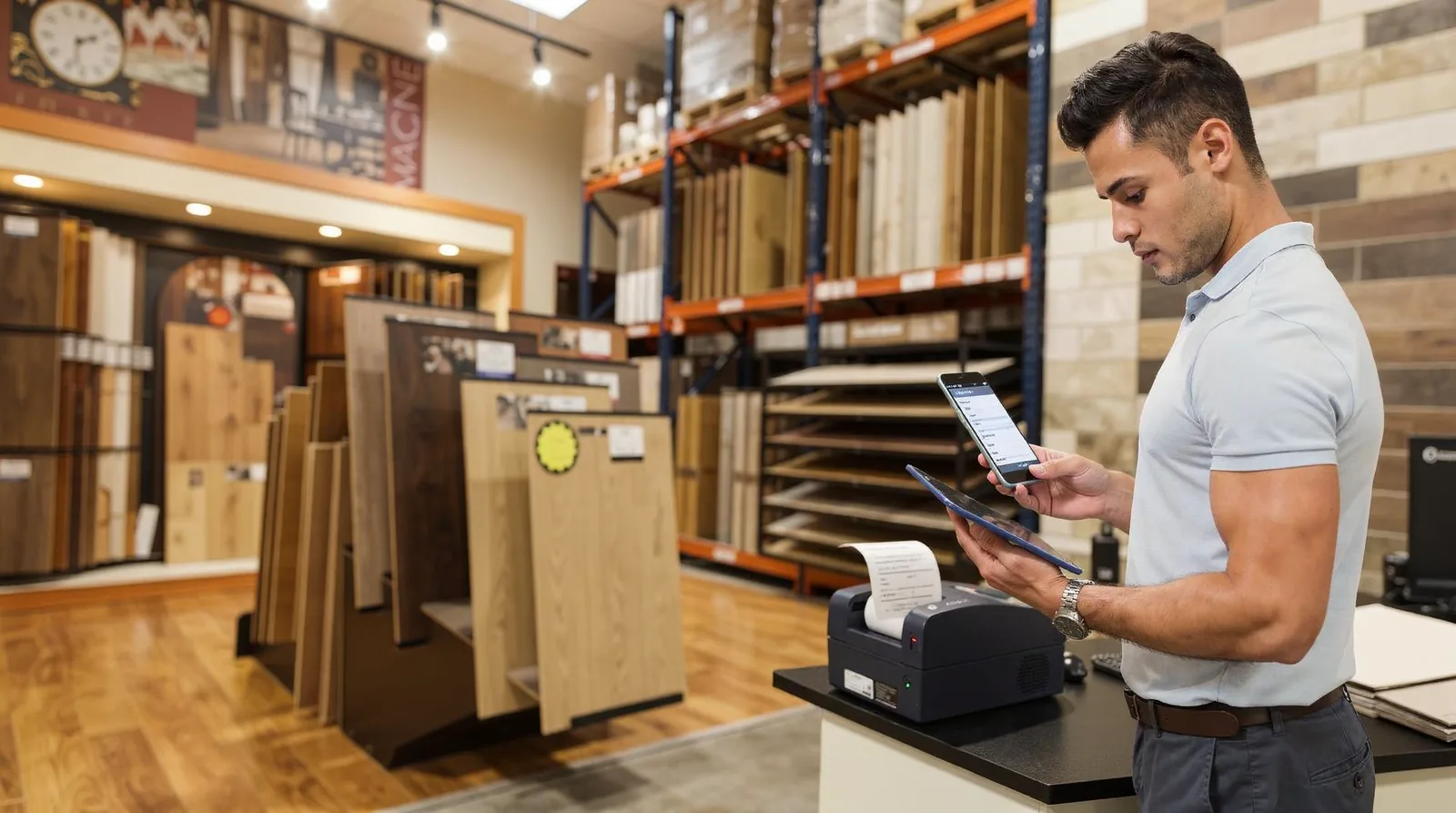
Cash-and-carry sales, pick-ticket printing, order conversion, purchase-order processing, and material tracking all fall within reach of an ERP dealer portal for warehouse management. Manufacturers and wholesalers gain a single connected system instead of separate, disconnected steps handled by different staff. Fulfillment speeds up because information moves automatically rather than through manual re-entry.
Showroom and warehouse counters benefit first. A connected portal processes cash-and-carry transactions quickly, including charges billed to subcontractors and tile setters holding open accounts. Staff spend less time reconciling paperwork and more time serving the next customer.
Does the portal handle order fulfillment on the warehouse floor?
Yes. An optional pick ticket prints directly at the warehouse, removing the manual handoff between an order entry and a completed pickup. That single automation shortens the sales cycle noticeably, since staff no longer wait on paperwork routed through separate departments.
Order flow benefits extend beyond the counter. Quotes convert directly into sales order jobs, which pushes material requests straight into the warehouse queue through Comp-U-Floor ERP. No re-keying, no lag between a signed quote and a warehouse pick request.
What else can a connected portal manage besides sales?
Material management sits alongside contractor scheduling and job tracking inside the same platform. Warehouse activity stays aligned with what happens in the field. Dealers and installers pull from one shared source of data.
Warehouse tasks an ERP dealer portal automates:
-
Cash-and-carry, Residential, and Commercial sales processing at showroom and warehouse counters
-
Subcontractor and tile-setter open-account billing
-
Pick-ticket generation at the warehouse
-
Quote-to-sales-order conversion
-
Material and inventory coordination tied to job scheduling
Businesses already running ERP software hold a real advantage here. That existing infrastructure becomes the foundation for extending efficiency gains into dealer-facing warehouse workflows, rather than starting from scratch.
How Does Dealer Portal Integration Reduce Fulfillment Errors?
Fulfillment errors drop sharply when dealers stop re-keying order data by hand. An ERP dealer portal for warehouse management connects directly with existing ERP CRM platforms instead of running as a separate, disconnected system. That single connection closes the gap where mismatched product codes, stale pricing, and duplicate orders typically creep in.
ERP software already functions as a complete organizational solution, managing supply chain operations, accounting, and other core processes in one place. Removing duplicate data entry matters here. Every manual re-entry point is a chance for an error to enter the fulfillment chain. Distribution leaders who consolidate these processes eliminate many of the small mismatches that snowball into shipping mistakes and inventory discrepancies.
What happens when warehouse data stays siloed?
Siloed systems force teams to reconcile numbers across spreadsheets, order forms, and separate portals. When data works together in one connected system instead, warehouse and fulfillment teams manage inventory far more efficiently than with fragmented tools.
That efficiency shows up in a few concrete ways:
-
Dealers see live, accurate inventory instead of outdated stock counts.
-
Orders sync automatically to the warehouse floor, skipping manual re-entry.
-
Pricing and product data stay consistent across every sales channel.
-
Managers catch discrepancies before they become shipping errors.
Does portal integration support multi-location growth?
Yes — an integrated ERP and dealer portal approach simplifies operations across multiple warehouses or store locations, not just a single site. This structure improves accuracy at scale. Every location pulls from the same connected data source rather than maintaining separate records.
For manufacturer and wholesaler leaders managing dealer networks, that consistency translates directly into fewer fulfillment disputes and faster order cycles. Accuracy compounds as the network grows, supporting scalable growth without adding proportional error risk.
What ERP Tools Support Point-Of-Sale and Warehouse Pickups?
Point-of-sale processing closes the loop on a warehouse transaction by issuing a sales invoice that reflects both charges and payment, a step built into the Comp-U-Floor ERP platform. That single document ties the counter sale to the pull ticket. Warehouse staff and dealers work from matching records instead of separate paper trails. An ERP dealer portal for warehouse management connects that invoicing step directly to inventory, cutting the lag between a confirmed sale and a completed pickup.
Sales pipeline stages add another layer of clarity. Deals move through phases such as Qualified, Specification, Estimating, Quote, Won, or Lost, giving warehouse teams a clear signal of which orders are locked and ready to pull. Staff no longer guess which quotes will convert; they see confirmed status before touching inventory.
How does real-time visibility reduce fulfillment errors?
Live tracking of deal values, order links, and activity logs lets warehouse managers anticipate demand rather than scramble after the fact. Dealers and distribution leaders gain a shared view of pending orders, reducing double-pulls and last-minute rush requests.
What role does system integration play in pickup accuracy?
Combining digital files with the right IT tools improves usability across the entire flooring operation, especially at the warehouse handoff point, as outlined in Comp-U-Floor’s guide to flooring software efficiency. When invoicing, pipeline status, and inventory data live in one connected system, fewer errors slip through.
Together, these tools give distribution leaders one dependable path from sale to shipment.
How Do You Get Started Maximizing Warehouse Efficiency?
Warehouse leaders start by connecting fulfillment data to the dealer network, not by overhauling every process at once. Comp-U-Floor ERP emerged from a partnership between software engineers. Flooring veterans carrying more than 30 years of combined management experience. That pairing shaped a system built around real operational friction, not theory. Slow workflows, inaccurate estimates, and messy inventory tracking drain hours from every shift. Purpose-built flooring software closes those specific gaps rather than offering a generic fix, a point explored further in Comp-U-Floor’s guide to flooring software efficiency.
An ERP dealer portal for warehouse management gives distributors a direct channel between stockroom data. Reseller ordering, cutting the back-and-forth that slows fulfillment. Instead of phone calls and manual lookups, dealers see live inventory and job status themselves.
What should a warehouse manager tackle first?
Start with visibility. Generate detailed job estimates, job details, and progress reports, then share them directly with dealers and customers through the Comp-U-Floor ERP platform. Transparency around timelines builds trust and reduces the status-check calls that pull staff away from picking and packing.
Does location or company background matter when choosing a system?
Support responsiveness often matters more than physical location, but background still signals reliability. Comp-U-Floor ERP operates out of Maitland, Florida, with a foundation built on decades of flooring management expertise.
Practical first steps include:
-
Auditing current estimate accuracy and inventory discrepancies
-
Mapping where dealer communication currently breaks down
-
Piloting shared progress reporting with one or two high-volume dealers
-
Measuring fulfillment time before and after portal adoption
Small, measured rollouts reveal ROI (Return-On-Investment), faster than a full-network launch on day one.
Maximizing warehouse efficiency through an ERP dealer portal represents a strategic investment in operational excellence for flooring and remodeling businesses. By centralizing inventory management, streamlining order processes, and enabling real-time visibility across your supply chain, you establish the foundation for sustainable growth and competitive advantage. Comp-U-Floor ERP® delivers the comprehensive tools necessary to transform warehouse operations into a profit-driving asset, allowing your team to focus on what matters most: serving your customers and expanding your business.
Optimizing Warehouse Operations with ERP Insights
An ERP dealer portal for warehouse management gives distribution and manufacturing teams real-time inventory visibility, self-service dealer ordering, and automated fulfillment tracking in one connected system. Together, these attributes address the two costliest warehouse failures — overstocking and stockouts — while cutting the manual data entry that drives fulfillment errors. Comp-U-Floor ERP ties estimating, inventory, order tracking, and point-of-sale invoicing into a single platform, so warehouse managers, dealers, and distribution leaders all work from the same accurate data. For teams ready to reduce fulfillment time and eliminate order errors, exploring how a dealer portal connects to your existing ERP is a practical next step toward a more efficient warehouse.
FAQ
How does an ERP dealer portal reduce overstocking?
It gives dealers real-time visibility into inventory before placing orders, replacing the pattern where many retailers hold a disproportionate amount of inventory relative to sales.
What causes warehouse inefficiency beyond excess stock?
Manual order processing, outdated stock counts, and phone- or spreadsheet-based ordering create disconnected records. Stockouts cause roughly 34% of retailers to ship orders late.
What warehouse tasks does Comp-U-Floor ERP’s dealer portal automate?
It automates cash-and-carry sales, pick-ticket printing, order conversion, purchasing, and material tracking within one cloud-based platform centralizing estimating, inventory, and order tracking.